
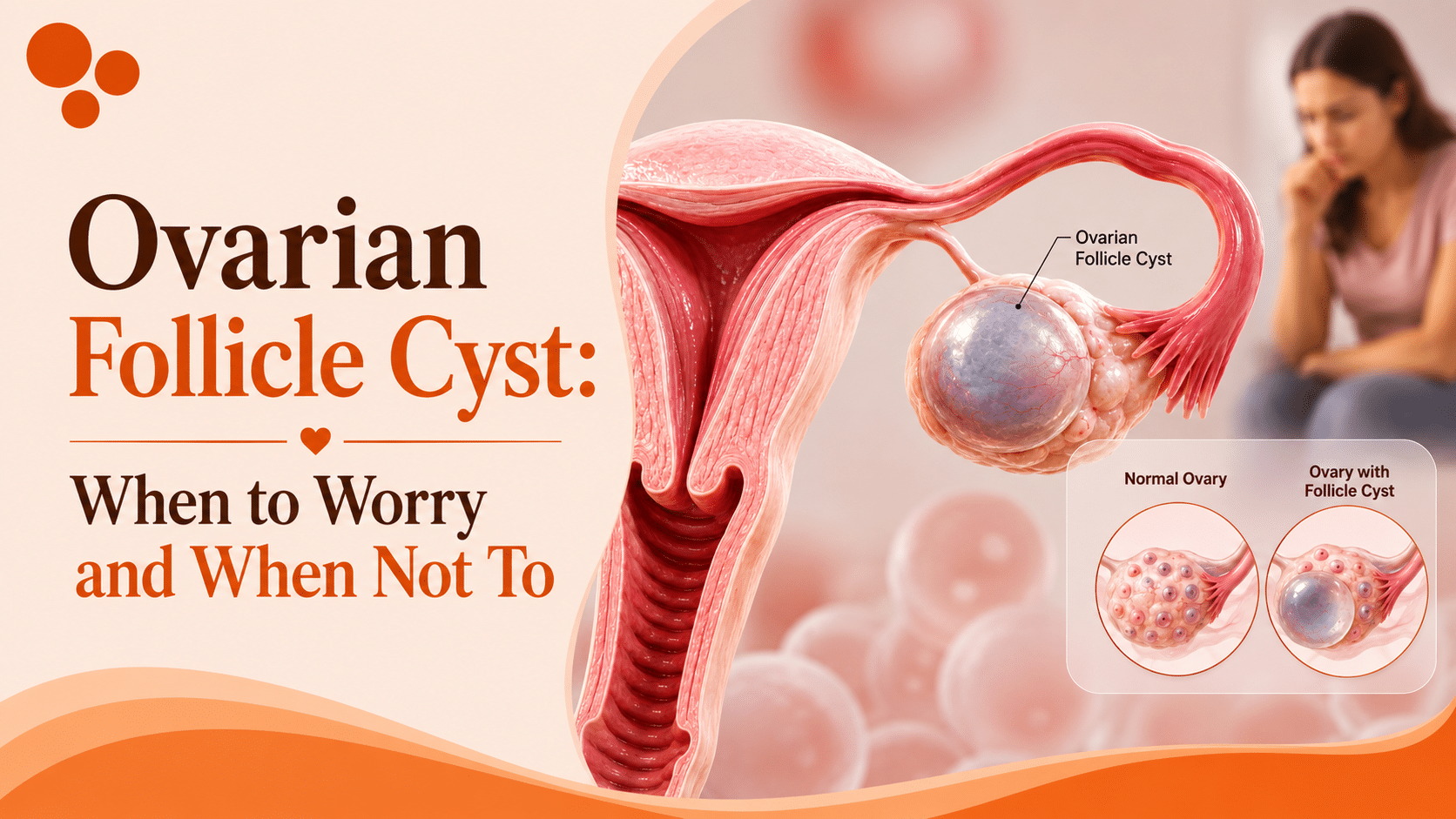
Blog Overview:
In this blog, we explain everything about an ovarian follicle cyst, including what it is, how it forms, what symptoms it causes, how it is diagnosed, when it needs treatment and when it resolves on its own, and how it affects fertility.
If your doctor told you that you have an ovarian follicle cyst, you might have come home feeling a little worried and a lot confused. What exactly is it? Is it dangerous? Does it affect your chances of getting pregnant? Do you need surgery?
These are all fair questions. And the good news is that most of the answers are reassuring. This blog explains everything clearly so you leave with understanding, not just more worry.
What Is an Ovarian Follicle Cyst?
Every month, your ovaries grow small, fluid-filled sacs called follicles. Each follicle holds a developing egg. During ovulation, one follicle grows larger than the others, eventually bursts open, and releases the egg. This is a completely normal part of the menstrual cycle.
But sometimes, the follicle does not burst open. Instead of releasing the egg and disappearing, it keeps filling with fluid and continues to grow. A follicular cyst forms when the follicle does not release the egg and keeps growing. This is what we call an ovarian follicle cyst.
It is one of the most common types of ovarian cysts and importantly, the vast majority of ovarian cysts are benign, cause no harm, and disappear on their own without treatment or lasting effects.
An ovarian follicle cyst is generally smooth, thin-walled, and filled with clear fluid. It is not cancer. It is not a tumour. But it is essentially an overgrown follicle that stayed behind when it should have released its egg and dissolved.
How Does an Ovarian Follicle Cyst Form?
Understanding the cause helps reduce the fear around this condition significantly.
Hormonal disruptions in the LH surge, often linked to PCOS or fertility drugs, drive follicular cyst formation and fluid accumulation.
LH (luteinising hormone) is the hormone that triggers ovulation. When this surge does not happen correctly, the follicle does not get the signal to release the egg. So it stays. And grows.
Other factors that can contribute to follicular cyst formation include:
- Hormonal imbalances: irregular oestrogen levels disrupting the normal cycle
- PMOS (previously known as PCOS): where multiple follicles develop but ovulation is irregular or absent
- Fertility medications: drugs that stimulate the ovaries during IVF can sometimes cause follicles to grow without releasing
- Stress: significant physical or emotional stress can disrupt the hormonal signals that regulate ovulation
- Thyroid disorders: an underactive or overactive thyroid can affect the hormones that drive ovulation
What are the Symptoms of an Ovarian Follicle Cyst?
Here is something that surprises many women that most ovarian follicle cysts produce no symptoms at all. They are discovered incidentally during a routine ultrasound or pelvic examination.
While most cystic ovarian follicles are asymptomatic, larger ones can cause pelvic pressure, irregular bleeding, or ovarian torsion.
When symptoms do occur, they may include:
- A dull ache or feeling of heaviness on one side of the lower abdomen
- A feeling of fullness or bloating in the pelvis
- Irregular or delayed periods
- Discomfort during sexual intercourse
- Pressure on the urinary bladder, which can lead to increased urinary frequency or urgency
Symptoms that need immediate attention:
A small number of ovarian cysts can rupture, meaning they break open or cause the ovary to twist (a condition called ovarian torsion). These are medical emergencies. Seek immediate medical attention if you experience:
- Sudden, severe, sharp pain in the lower abdomen
- Pain accompanied by fever and vomiting
- Dizziness, fainting, or rapid heartbeat alongside abdominal pain
⚠️ Important Note: Do not try to self-diagnose or manage ovarian cyst symptoms on your own. If you have any pelvic pain, irregular periods, or symptoms mentioned above, please see a qualified gynaecologist or specialist who can properly evaluate your situation and recommend the right next step.
How Is an Ovarian Follicle Cyst Diagnosed?
Diagnosis is usually straightforward. Diagnosis relies mainly on transvaginal ultrasound, which typically shows a simple, thin-walled, unilocular ovarian cyst.
A transvaginal ultrasound gives a very clear picture of the ovaries. The doctor looks at the size, shape, and contents of the cyst whether it is simple and fluid-filled, or more complex with solid areas or multiple chambers. This distinction is important because it helps determine whether the cyst is a simple follicular cyst or something that needs closer investigation.
Additional investigations your doctor may recommend:
- Blood test for CA-125: a marker sometimes elevated in ovarian conditions. Note that elevated CA-125 does not automatically mean cancer but it can be raised in many benign conditions too
- Hormone panel: to check oestrogen, LH, FSH, and other hormones that might explain why the follicle failed to ovulate
- AMH test: if there is concern about ovarian reserve
Does an Ovarian Follicle Cyst Need Treatment?
In most cases no. Not immediately, and often not at all. Management primarily involves watchful waiting with follow-up imaging, as most cyst follicles resolve spontaneously within 2 to 3 menstrual cycles.
This means your doctor will monitor the cyst with a follow-up ultrasound usually after 6 to 12 weeks to check whether it has shrunk or disappeared on its own. In the vast majority of cases, it does.
The decision about treatment depends on your specific situation, the cyst’s size and characteristics, your age, your symptoms, and whether you are trying to conceive. This decision should always be made in consultation with a qualified specialist.
Ovarian Follicle Cyst and Fertility: What Is the Impact?
This is the question most women are most concerned about. And the answer is nuanced as it depends on the type and cause of the cyst.
Sometimes, the illness causing the cyst can make it difficult to get pregnant. Two conditions that cause ovarian cysts and affect fertility are endometriosis and polycystic ovary syndrome.
A simple ovarian follicle cyst on its own, a single, straightforward follicle that did not release does not typically cause lasting fertility problems. It may delay ovulation in that particular cycle, but once it resolves, normal ovulation usually resumes.
However, if follicular cysts are happening repeatedly every cycle, it may indicate an underlying issue with ovulation that needs investigation. This is worth discussing with a fertility specialist particularly if you have been trying to conceive for some time without success.
A research study published in Frontiers in Endocrinology in June 2025 which looked at 474 women with different types of ovarian cysts found that women with ovarian cysts had significantly lower AMH and AFC levels and higher FSH levels compared to controls. The impact varied significantly by cyst type, with endometriomas having the most pronounced effect on ovarian reserve. Simple follicular cysts had a comparatively smaller impact.
Can an Ovarian Follicle Cyst Be Prevented?
You cannot prevent functional ovarian cysts if you are ovulating. Because they are part of the natural ovulatory process, a normal follicle that simply did not release, they cannot be entirely eliminated through lifestyle changes.
That said, managing underlying conditions that disrupt ovulation such as PMOS, thyroid disorders, or significant hormonal imbalances can reduce how frequently follicular cysts form. Maintaining a healthy weight, managing stress, and addressing hormonal issues with medical support all contribute to more regular ovulation.
Final Thoughts
An ovarian follicle cyst is a common, usually harmless, and typically self-resolving condition. For most women, it requires nothing more than a watchful eye and a follow-up scan. It is not cancer. It is not automatically a barrier to pregnancy. And in most cases, it disappears on its own within a few cycles.
What matters most is understanding your specific situation, including the size of the cyst, whether it is causing symptoms, and whether there is an underlying hormonal or reproductive issue driving repeated cyst formation.
If you are in Uttar Pradesh or nearby and exploring your options, there are experienced fertility centres available to guide you through this. For those searching for a Best IVF Centre Bulandshahr or surrounding areas, take time to understand your condition fully and have a proper consultation with a specialist before making any treatment decisions.
Frequently asked questions (FAQs)
- Is an ovarian follicle cyst dangerous?
Most ovarian follicle cysts are harmless and resolve on their own within 2 to 3 menstrual cycles. They are not cancerous. However, large cysts or those causing severe pain need prompt medical attention.
- Can an ovarian follicle cyst prevent pregnancy?
A single follicular cyst may delay ovulation in one cycle but does not typically cause lasting fertility problems. Recurring follicular cysts may indicate an underlying ovulation issue worth investigating with a specialist.
- Does an ovarian follicle cyst always need surgery?
No. Most follicular cysts are managed with watchful waiting and resolve without any treatment. Surgery is only considered for very large cysts, cysts causing complications, or those that do not resolve over time.
- How is an ovarian follicle cyst different from a PMOS cyst?
An ovarian follicle cyst is usually a single, larger follicle that did not release its egg. PMOS involves many small follicles on both ovaries along with hormonal imbalances. They are related but not the same condition.
- Can an ovarian follicle cyst come back after it resolves?
Yes. If the underlying cause such as irregular ovulation or hormonal imbalance is not addressed, follicular cysts can recur in subsequent cycles.
