
Quick Overview
AI in healthcare gets talked about everywhere, but most articles stay vague. This blog looks specifically at how AI in healthcare is actually being used in fertility treatment and IVF today, based on real published research, not speculation. You’ll see where the technology genuinely helps, where it’s still being tested, and why the most talked-about use isn’t necessarily the most reliable one yet.
Why Fertility Care Is a Natural Fit for AI
IVF generates enormous amounts of image-based and numerical data, embryo photos, ultrasound scans, hormone levels, and cycle outcomes. This makes fertility treatment one of the more natural areas for AI in healthcare to be tested and applied. It’s no surprise that adoption has grown quickly: research published in 2026 shows that professional use of AI tools among IVF specialists rose from roughly 25 percent in 2022 to over 53 percent in 2025, in just three years.
But rapid adoption doesn’t automatically mean every application is equally proven. That distinction matters a lot here.
The Big Question: Can AI Really Pick the Best Embryo?
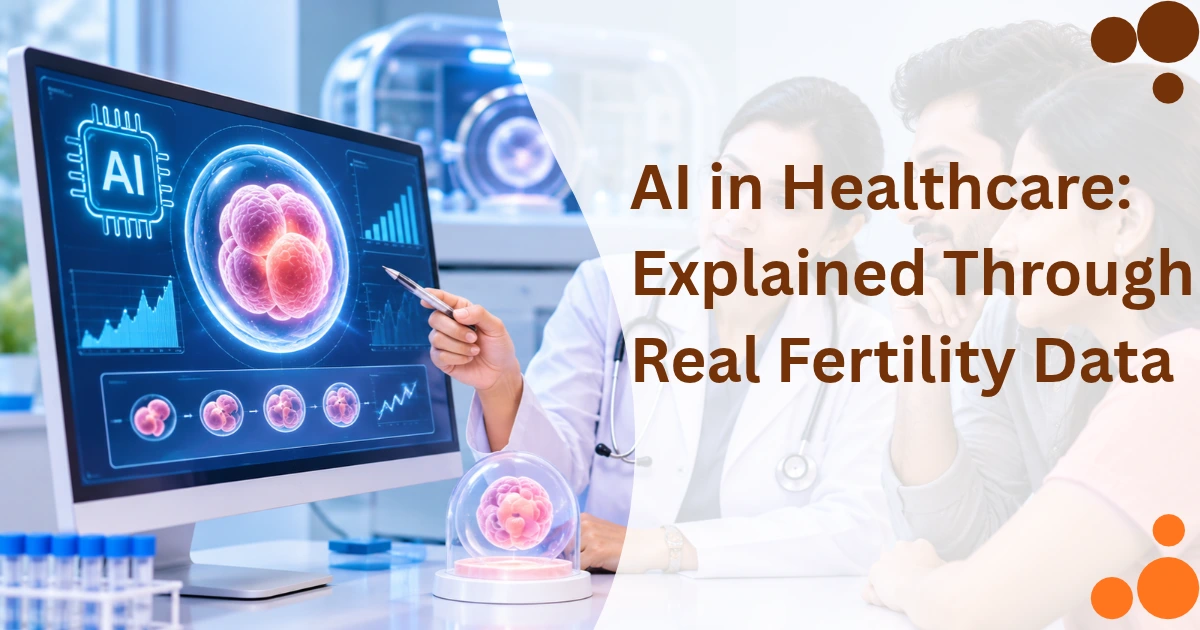
This is probably the most talked-about promise of AI in healthcare within fertility clinics, using AI to help choose which embryo has the best chance of resulting in a healthy pregnancy. And there’s genuinely encouraging data behind it.
A large multicentre study published in 2026, evaluating an AI scoring model against 20 embryologists across more than 1,600 embryo pairs, found the AI model reached about 70 percent accuracy, outperforming the average individual embryologist and performing close to expert consensus level. Separately, in September 2025, the first machine learning embryo assessment tool received official FDA clearance, a genuinely significant regulatory milestone.
But Here’s the Honest Part Most Articles Skip
This is where AI in healthcare needs a more careful look. A landmark randomized, double-blind trial published in Nature Medicine in 2024 compared deep learning-based embryo selection directly against manual assessment by embryologists. The result was a noninferiority finding, meaning the AI performed about as well as manual selection, not clearly better.
More recently, a 2026 study in Fertility and Sterility, highlighted by ASRM, found that several widely used AI embryo selection models showed real instability, meaning the same embryo could sometimes receive noticeably different rankings depending on which version of the model or dataset was used. ASRM’s own committee opinion urges caution here, noting that inconsistencies in how embryos were originally labelled for training can become built into the AI model itself.
So the honest picture is this: AI shows real promise for embryo selection, but it isn’t yet a settled, universally superior replacement for experienced embryologists.
AI in Healthcare: Where It’s Actually More “Ready” Right Now
Interestingly, recent research suggests the flashiest application of AI in healthcare, embryo selection, isn’t necessarily the most clinic-ready one. A 2026 analysis in Frontiers in Endocrinology identified three AI applications as immediately deployment-ready, requiring no new hardware:
- Outcome prediction: Using AI to estimate a patient’s likely chances of success based on their specific profile and history.
- Stimulation dosing: Assisting doctors in personalising medication doses during ovarian stimulation.
- Quality tracking (RFID-based systems): Helping labs track samples accurately throughout the IVF process.
According to this research, outcome prediction, the least talked-about of these, currently has the greatest near-term practical impact, even though it gets far less public attention than embryo selection.
AI Is Also Changing Routine Monitoring, Quietly
Beyond embryo selection, AI in healthcare is showing up in less publicised but genuinely useful ways. Research presented at the ASRM 2025 Congress found that an AI model for measuring ovarian follicle size performed comparably to expert sonographers, a task doctors rely on constantly during IVF monitoring. Similar AI tools are also being tested for measuring the endometrial lining, another key factor doctors track before embryo transfer.
These applications may sound less exciting than “AI picks your best embryo,” but they represent some of the more immediately reliable uses of this technology in everyday fertility care.
What This Means for Patients Right Now
If your fertility clinic mentions using AI, here’s a grounded way to think about it:
- AI tools are generally used to support and standardise decisions, not replace your medical team entirely.
- Embryo selection AI can be a helpful second opinion, but it works alongside, not instead of, experienced embryologists.
- Applications like outcome prediction and monitoring are increasingly reliable and already in use at many clinics.
Important Note
Please don’t choose a fertility clinic, or make treatment decisions, based solely on marketing claims about AI in healthcare, without understanding which specific tools are being used and how. AI is a rapidly evolving, genuinely promising area of fertility care, but current research shows it works best as a support tool alongside experienced specialists, not as a standalone decision-maker. Please consult a qualified fertility specialist to understand how, and whether, AI-based tools are appropriately used in your specific treatment plan. If you’re evaluating clinics on this basis, it’s worth checking what a centre like the best IVF centre Karnal offers, so you can see their facilities and specialists before deciding where to go for further evaluation.
Bringing It All Together
AI in healthcare is making a genuine, measurable difference in fertility treatment, though not always in the way headlines suggest. Embryo selection gets the most attention, and shows real promise, but current research reveals it’s still maturing, with documented consistency challenges. Meanwhile, quieter applications like outcome prediction, stimulation dosing, and follicle tracking are already proving reliable in everyday practice. Understanding this fuller picture helps you engage with your fertility care more informedly, rather than relying on the technology’s reputation alone.
Frequently Asked Questions (FAQs)
- Is AI in healthcare already being used in IVF clinics today?
Yes, adoption has grown significantly, with over half of surveyed IVF professionals reporting AI tool use by 2025, up from about a quarter in 2022.
- Can AI accurately pick the best embryo for transfer?
Research shows promising accuracy, around 70 percent in some studies, often matching or slightly exceeding average embryologist performance, though it’s not yet definitively superior.
- Are there concerns about AI embryo selection models?
Yes, a 2026 study found some models showed inconsistency in rankings, and ASRM has urged caution around relying on AI as a sole decision-maker.
- What AI application in fertility care is considered most reliable right now?
Outcome prediction, estimating a patient’s likely chances of IVF success, is currently considered one of the most deployment-ready applications.
- Can AI help with ultrasound monitoring during IVF?
Yes, studies presented at recent conferences show AI models measuring follicle size performing comparably to expert sonographers.
- Does AI replace embryologists in the IVF lab?
No, current evidence supports AI as a supportive tool alongside embryologists, not a replacement for their expertise.
- Why does AI model instability matter for patients?
It means the same embryo could receive different rankings depending on the specific AI model used, which is why oversight and validation remain important.
- Should I choose a clinic based on whether they use AI?
Not solely. It’s more useful to understand which specific AI tools a clinic uses and how they integrate them into overall care.
https://www.google.com/maps/place/Embryologist+%7C+RISAA+IVF+%26+Fertility+Center,+Karnal/@29.686002,76.990472,17z/data=!3m1!4b1!4m6!3m5!1s0x390e71090767f673:0x590c9806160486bf!8m2!3d29.686002!4d76.990472!16s%2Fg%2F11z47pv7v9?entry=ttu&g_ep=EgoyMDI2MDYwMS4wIKXMDSoASAFQAw%3D%3D
